

Stanley Black & Decker has had an impressive run over the past six months as its shares have beaten the S&P 500 by 10.9%. The stock now trades at $89.05, marking a 32.1% gain. This was partly due to its solid quarterly results, and the run-up might have investors contemplating their next move.
Is now the time to buy Stanley Black & Decker, or should you be careful about including it in your portfolio? See what our analysts have to say in our full research report, it’s free.
Why Do We Think Stanley Black & Decker Will Underperform?
We’re glad investors have benefited from the price increase, but we don’t have much confidence in Stanley Black & Decker. Here are three reasons why there are better opportunities than SWK, plus one stock we’d rather own.
1. Core Business Falling Behind as Demand Plateaus
We can better understand Professional Tools and Equipment companies by analyzing their organic revenue. This metric gives visibility into Stanley Black & Decker’s core business because it excludes one-time events such as mergers, acquisitions, and divestitures along with foreign currency fluctuations - non-fundamental factors that can manipulate the income statement.
Over the last two years, Stanley Black & Decker failed to grow its organic revenue. This performance was underwhelming and implies it may need to improve its products, pricing, or go-to-market strategy. It also suggests Stanley Black & Decker might have to lean into acquisitions to accelerate growth, which isn’t ideal because M&A can be expensive and risky (integrations often disrupt focus). 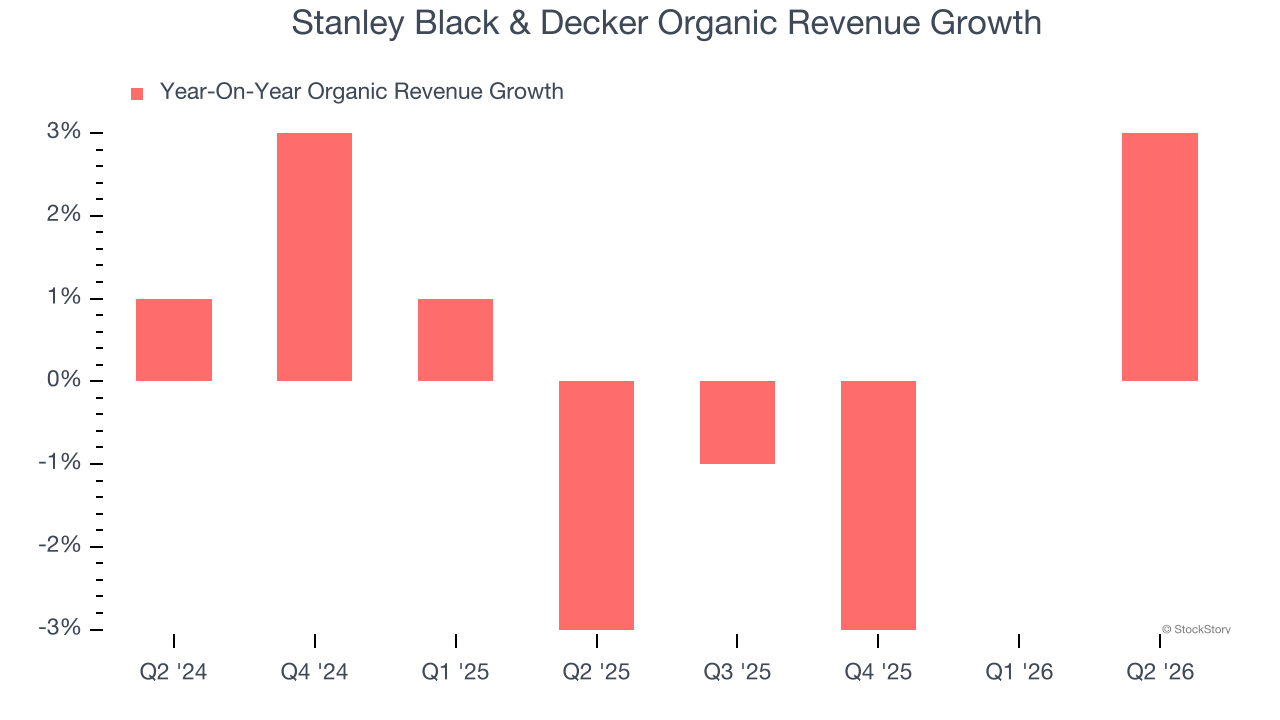
2. Projected Revenue Growth Shows Limited Upside
Forecasted revenues by Wall Street analysts signal a company’s potential. Predictions may not always be accurate, but accelerating growth typically boosts valuation multiples and stock prices while slowing growth does the opposite.
Over the next 12 months, sell-side analysts expect Stanley Black & Decker’s revenue to stall, close to its flat result for the past five years. This projection is underwhelming and suggests its newer products and services will not accelerate its top-line performance yet.
3. EPS Trending Down
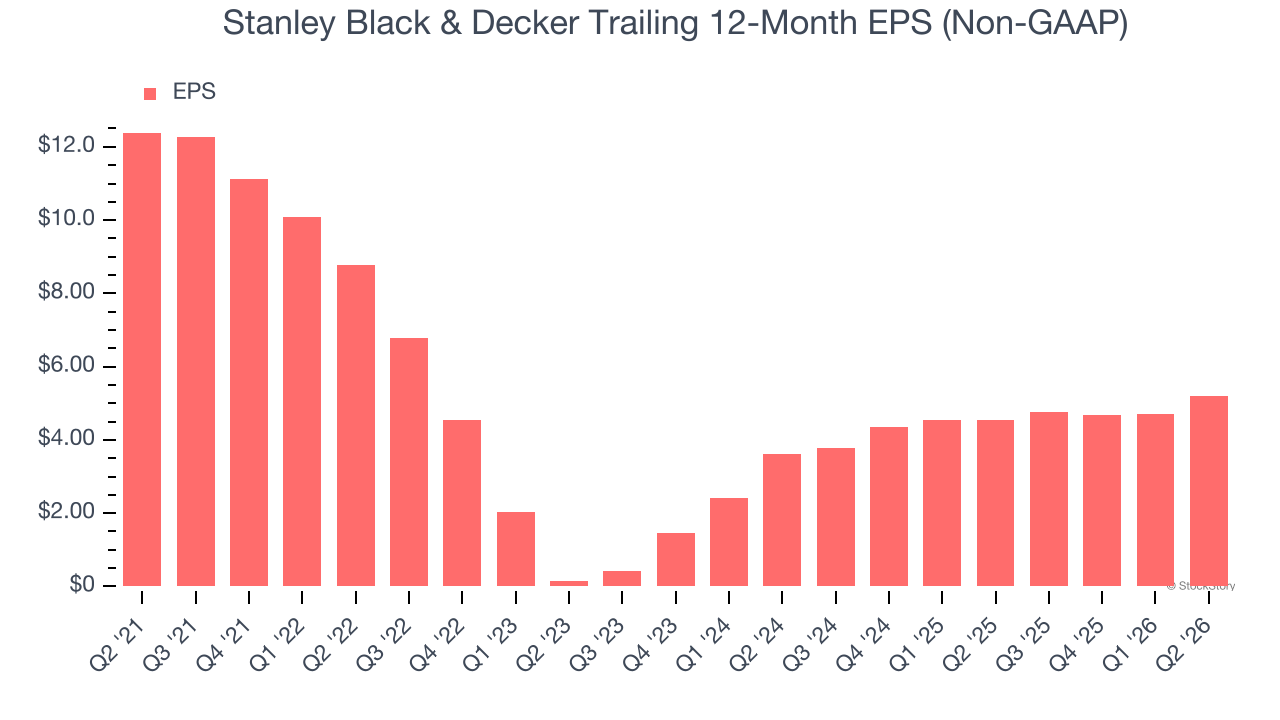
We track the long-term change in earnings per share (EPS) because it highlights whether a company’s growth is profitable.
Sadly for Stanley Black & Decker, its EPS declined by 15.9% annually over the last five years while its revenue was flat. This tells us the company struggled because its fixed cost base made it difficult to adjust to choppy demand.
Final Judgment
Stanley Black & Decker falls short of our quality standards. With its shares topping the market in recent months, the stock trades at 15.2× forward P/E (or $89.05 per share). While this valuation is reasonable, we don’t see a big opportunity at the moment. There are superior stocks to buy right now. We’d recommend looking at the Amazon and PayPal of Latin America.
High-Quality Stocks for All Market Conditions
WHILE YOU’RE HERE: Top 9 Market-Beating Stocks. The best stocks don’t just beat the market once. They do it again. And again. Robust revenue growth, rising free cash flow, returns on capital that leave their competition in the dust. The market has already rewarded these businesses.
But our AI platform says the party isn’t over. Find out which 9 stocks made the cut this week — FREE. Get Our Top 9 Market-Beating Stocks for Free HERE.
Stocks that have made our list include now familiar names such as Nvidia (+1,460% between June 2020 and June 2025) as well as under-the-radar businesses like the once-micro-cap company Kadant (+214% between June 2020 and June 2025). Find your next big winner with StockStory today.